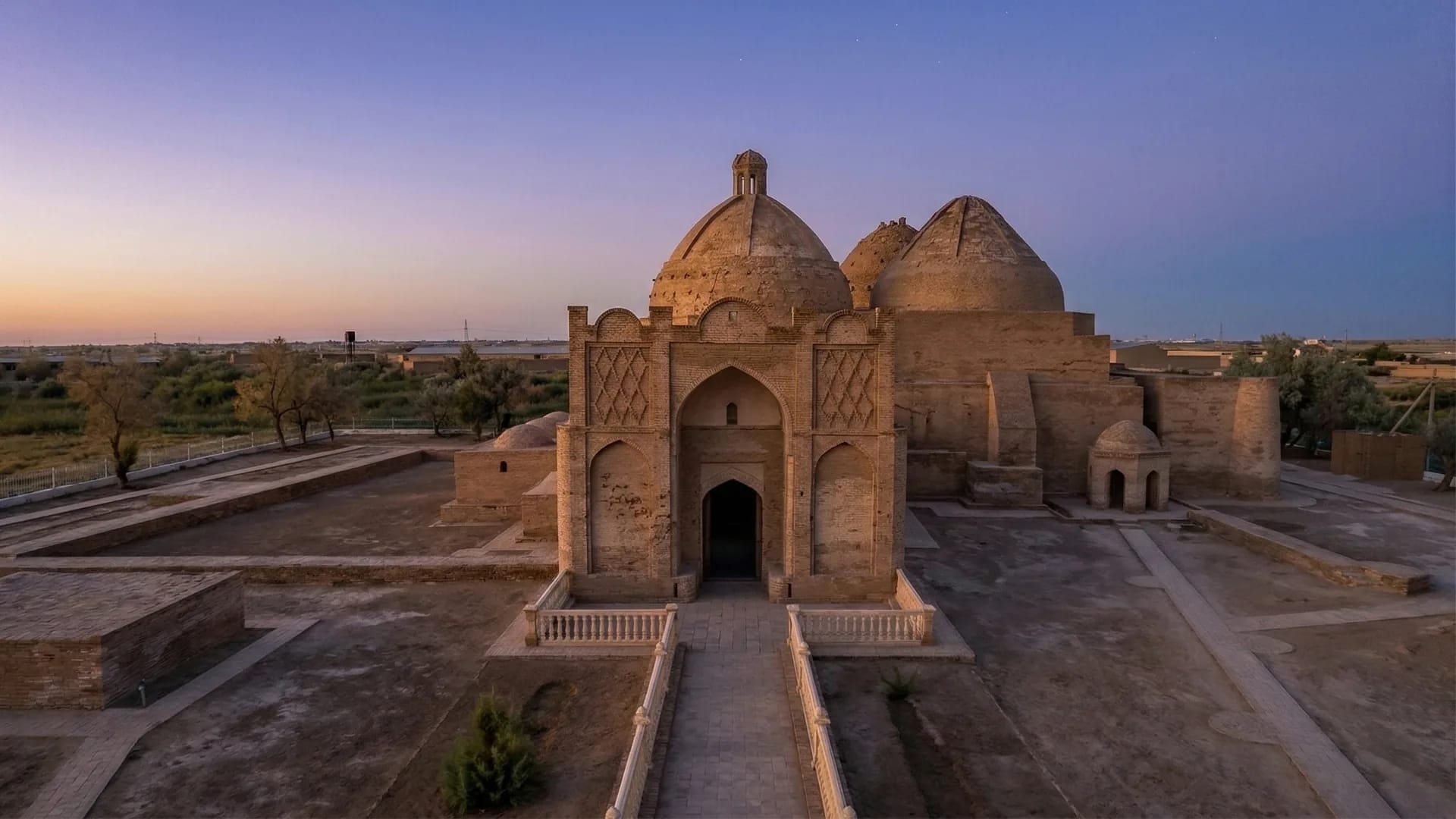
Astana-Baba Mausoleum
An 11th-12th century mausoleum complex in Lebap velayat covered in intricate carved terracotta, revered as a major pilgrimage site across the region.
Quick Navigation
Overview
The site sits in the Atamyrat district, on the right bank of the Amu Darya. This location is no accident - the Amu Darya corridor was one of the great arteries of medieval Islamic civilization, carrying goods, ideas, and craftspeople between Khorasan and the steppes. The architects and decorators who worked here were part of a broader world of skilled artisans moving between courts and holy sites. The terracotta ornamentation - geometric interlace, vegetal scrollwork, calligraphic friezes - reflects both local tradition and the wider visual language of the Seljuk empire.
The complex comprises multiple structures, including portal arches and domed chambers, built and extended across different periods. What visitors encounter today is a layered architectural biography: original medieval fabric, later additions, and restoration work all coexisting on the same site. The carved decoration is the constant thread. Running your eye across a single panel, you find patterns that resolve and recurse in a way that feels almost mathematically deliberate - because it was.
Astana-Baba has never stopped being a place of active devotion. Pilgrims visit throughout the year, particularly around religious observances, to pay respects at what is considered a sacred tomb. The atmosphere on a busy visiting day has a quality distinct from purely archaeological sites: incense, the murmur of prayer, fabric tied to nearby posts. The medieval and the contemporary share the same courtyard without apparent contradiction.
There is a detail here worth noting: the name itself, roughly translating to "the sacred threshold of the father/elder," has been applied to a site whose precise occupant remains a matter of scholarly debate. Venerated for centuries, visited by the faithful from across the region - and yet the historical identity of the person buried here is not definitively established. History, in Central Asia, has a way of making the mystery part of the monument.
Highlights
Why Visit
- See medieval carved terracotta in Central Asia that has endured nearly a thousand years intact
- Visit a site that has functioned continuously as a place of pilgrimage since the Seljuk period
- Witness the coexistence of living religious practice and outstanding medieval architecture on a single site
- Understand the depth of Seljuk cultural reach through ornamental patterns carved into Lebap stone
- Reach one of the finest examples of Seljuk-era funerary architecture in Central Asia, well off the typical tourist circuit
Best Time to Visit
April through June and September through October provide the most agreeable temperatures along the Amu Darya corridor, with conditions comfortable for outdoor exploration of the complex. Summer temperatures in Lebap velayat climb well above 40°C (104°F), making midday visits taxing. Winter brings cold nights but clear, calm days that can be ideal for photography of the terracotta details in low-angle light.
Getting There
The mausoleum is located near Atamyrat in Lebap velayat, a long drive east from Ashgabat or reachable by domestic flight to the Turkmenabat airport followed by a road transfer. Roads in the region are generally paved. Our team arranges all logistics including the onward drive to the complex from the nearest town.
Quick Navigation
Plan Your Visit
Let our travel experts help you plan the perfect visit to this destination.
Inquire NowReady to Plan Your Journey?
Let our travel experts craft your perfect Turkmenistan adventure.
Chat with a Trip Expert