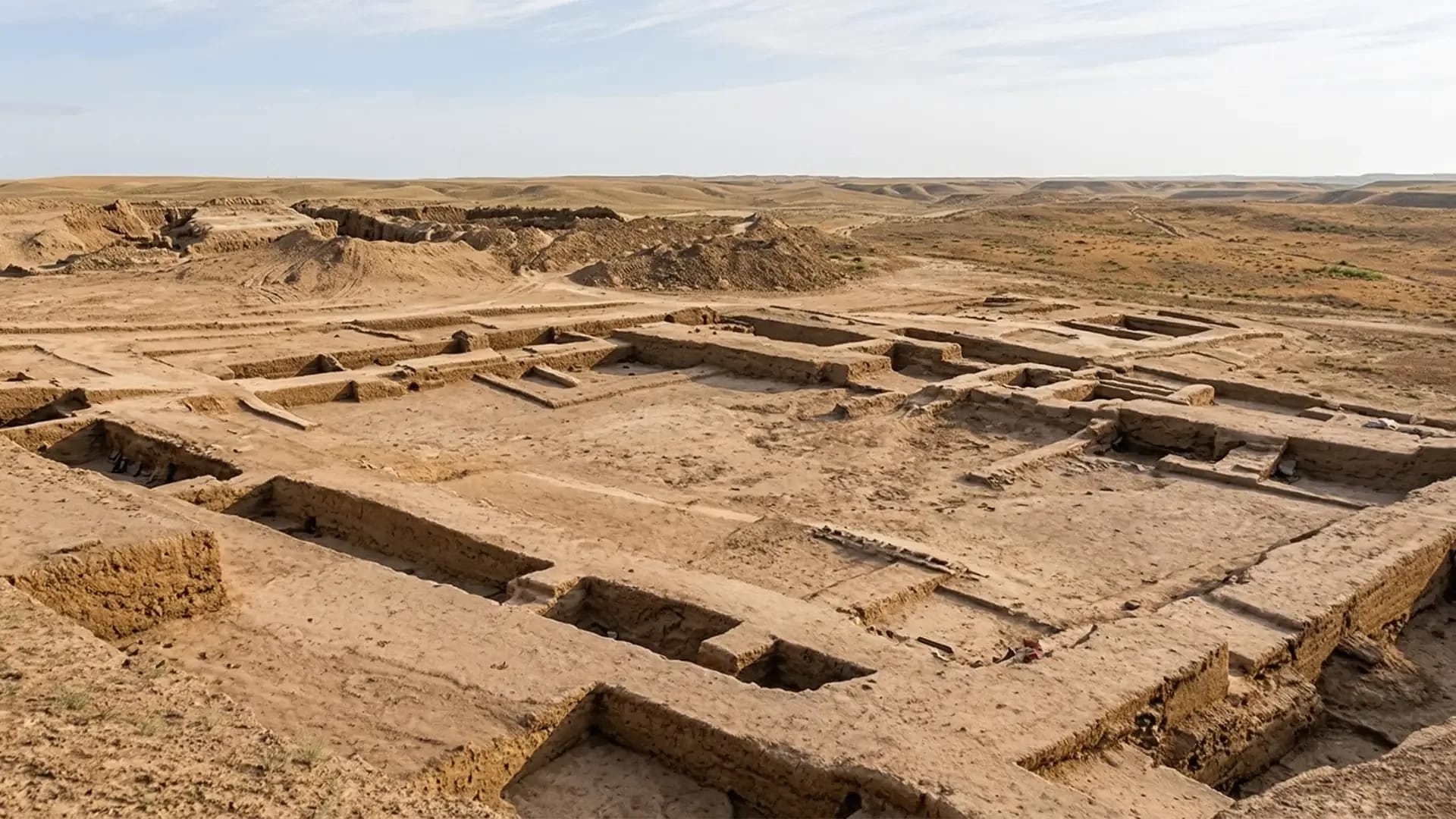
Altyn Depe
A Bronze Age tell in Mary velayat where archaeologists uncovered a pre-literate urban civilization roughly four thousand years old, contemporaneous with early Mesopotamian cities.
Quick Navigation
Overview
Soviet archaeologists began systematic excavations at Altyn Depe - meaning "Golden Hill" in Turkmen - in the mid-20th century, and what they found rewrote assumptions about the reach of Bronze Age urbanism. The site shows evidence of organized architecture, craft specialization, long-distance trade, and ritual structures including a multi-tiered stepped monument that some researchers have compared in form, if not in scale, to the ziggurats of ancient Mesopotamia. Artisans here produced fine ceramics and metalwork; their goods appear to have traveled considerable distances across the ancient world.
Altyn Depe belongs to the Namazga cultural sequence - a series of Bronze Age cultures that developed in the piedmont zone of what is now Turkmenistan and Iran. Its peak urban phase, dating to roughly 2300-1900 BCE, overlaps with the emergence of the broader Bactria-Margiana Archaeological Complex across the ancient Central Asian world. The civilization that built it left no written records, which means everything we know comes from the objects themselves and the bones of their city.
For the visitor, the experience is contemplative rather than spectacular. The mound is large; the excavated areas reveal stone foundations, walls, and spaces that read as rooms and streets only once a guide has oriented you. But the mental arithmetic is worth doing: over four thousand years ago, people organized enough to build this were living here - planting crops, trading goods, conducting rituals - while much of Europe was still managing with scattered farming villages.
Altyn Depe is not a monument to a civilization the world knows well. That is almost entirely the point.
Highlights
Why Visit
- Stand on a Bronze Age city that predates most of recorded history by over four millennia
- Visit one of the few excavated Namazga-period sites accessible to international travelers
- Grasp the true depth of Central Asian civilization - older than Greece, older than Rome
- Combine with the UNESCO ruins of Merv for a Mary velayat deep-time history itinerary
- See a site that Soviet archaeologists spent decades uncovering - still largely unknown to the wider world
Best Time to Visit
March through May offers the most comfortable conditions for visiting Altyn Depe, with mild temperatures between 18-28°C (64-82°F) and clear skies that make the open mound site easy to explore. October is also excellent - the heat has broken and the surrounding plains are dry underfoot. June through August is genuinely difficult: the site is fully exposed, there is no shade on the mound itself, and temperatures in Mary velayat regularly reach the upper 30s Celsius (100°F+). Winter visits are quiet and cool, with January temperatures occasionally dropping near freezing.
Getting There
Altyn Depe is located in Mary velayat, in southern Turkmenistan, not far from the city of Mary - the regional hub and access point for the area's major archaeological sites including the UNESCO-listed Merv. Most visitors combine Altyn Depe with a Merv itinerary as part of a multi-day tour from Ashgabat. Domestic flights connect Ashgabat to Mary Airport; overland travel from Ashgabat takes most of a day by road. Our tours coordinate all transport and provide specialist archaeological guides for the site.
Quick Navigation
Plan Your Visit
Let our travel experts help you plan the perfect visit to this destination.
Inquire NowReady to Plan Your Journey?
Let our travel experts craft your perfect Turkmenistan adventure.
Chat with a Trip Expert